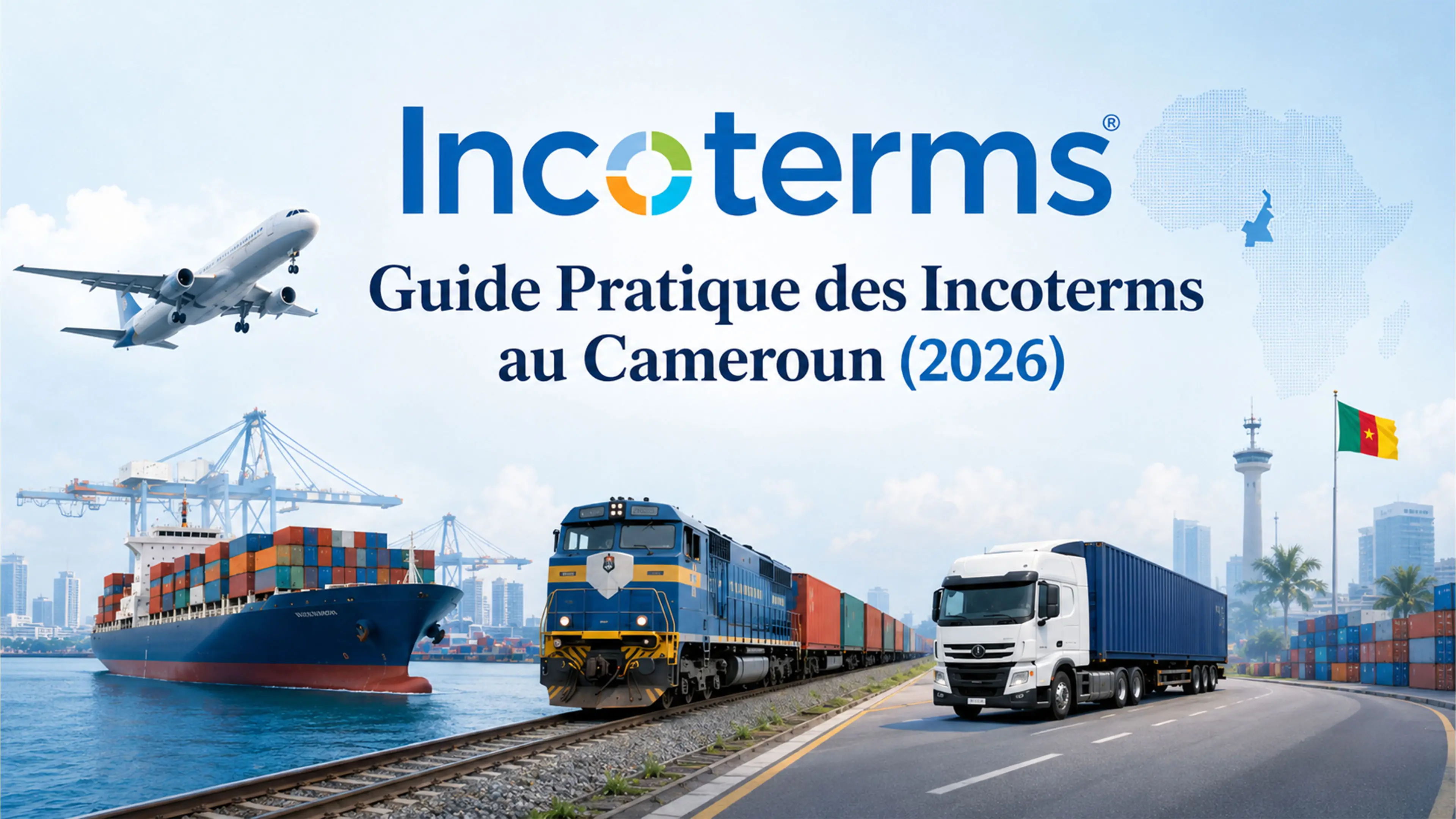
1. Two major legal and customs specifics in Cameroon
A. Local insurance obligation (CIMA Code — article 53). In the CIMA zone (including Cameroon), the law requires cargo insurance on imported goods to be taken out with a locally licensed company.
Impact on CIF: if you buy CIF, the foreign seller includes foreign insurance. On arrival at Douala or Kribi, Customs requires a local insurance certificate to validate the file on GUCE. You risk invalidating the document or paying twice for insurance.
Recommendation: prefer FOB or FCA, then take out cargo insurance directly in Cameroon.
B. Customs value in CAMCIS (CIF / CAF value). Cameroon Customs assesses duties and taxes on CIF (cost, insurance, freight) value. Even if you buy EXW or FOB, Customs systematically rebuilds CAF value in CAMCIS by adding to the purchase price:
- Freight (from the B/L or the actual quotation).
- Insurance (local premium or Customs scale).
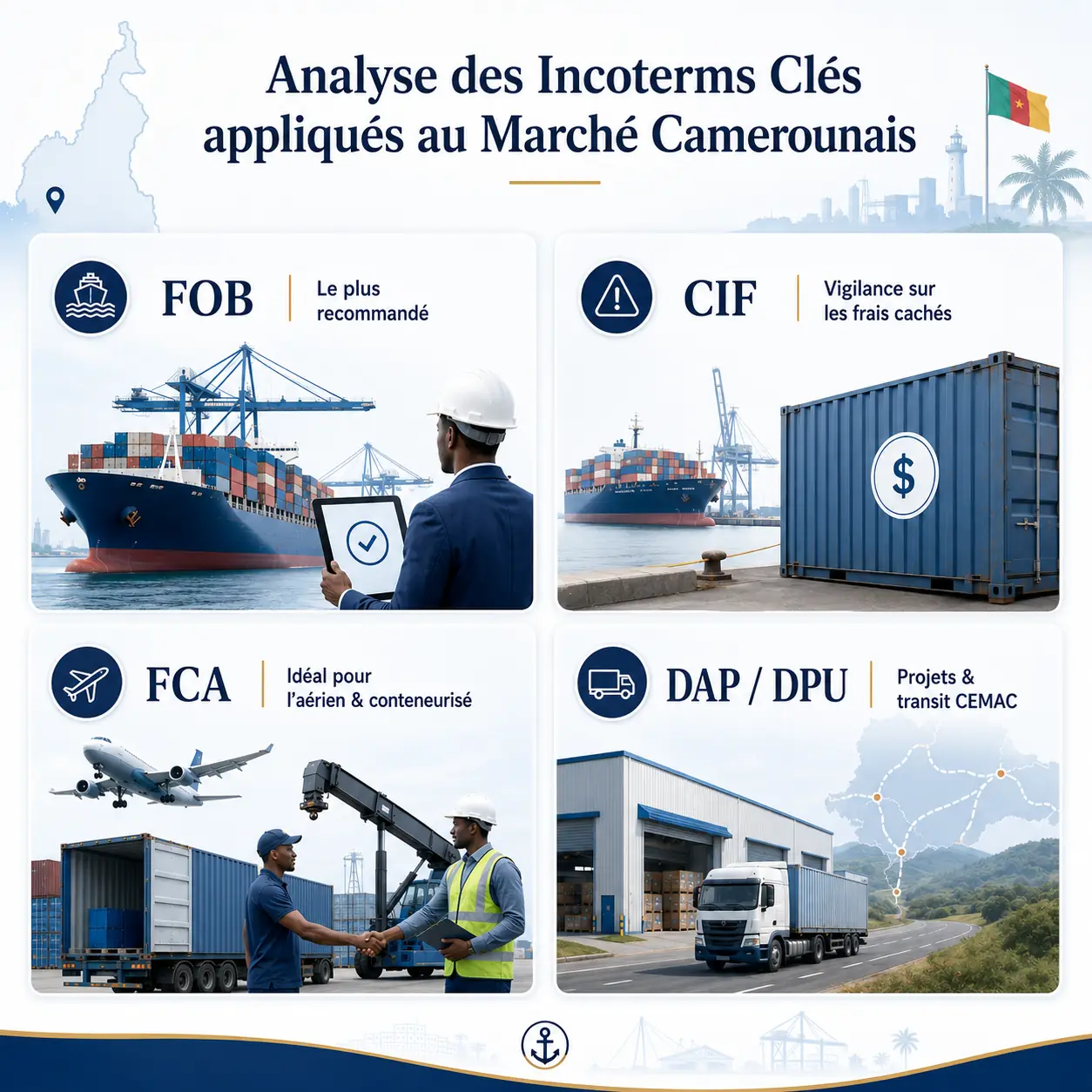
2. FOB (Free On Board): the ROI Incoterm for sea imports into Cameroon
The seller delivers the goods on board the vessel at the port of shipment (Ningbo, Guangzhou, Le Havre…). You, the Cameroonian buyer, control the shipping line, the freight rate and the local insurer.
On-the-ground advantage: you negotiate longer demurrage-free periods (often 14 to 21 days granted by the carrier at Douala/Kribi) through your forwarder or licensed customs broker.
3. CIF (Cost, Insurance & Freight): false friends and hidden costs in Douala and Kribi
The Chinese or European seller pays freight and insurance to the arrival port. That looks comfortable, but the seller often picks the cheapest line, which then applies high inbound / THC charges at the shipping-agent counters in Douala.
The risk: very short free time (e.g. 7 days), which quickly triggers demurrage even before the release note (BAE) is issued.
4. FCA (Free Carrier): the best alternative for containers and air freight
For air freight (Douala / Yaoundé-Nsimalen airports): ideal, because the goods are handed to the air carrier before uplift.
For containerised sea freight: a better substitute for FOB. The seller clears export customs and delivers the container to the departure terminal.
Negotiating a FOB, CIF or FCA contract? Validate the Incoterm before cargo is loaded.
5. DAP (Delivered At Place) / DPU: industrial projects and CEMAC transit
For the local market: the seller delivers to your warehouse in Douala or Yaoundé, but you handle import clearance and taxes.
For hinterland transit (Chad / CAR): allows T1 movement of equipment or mining / oil project cargo to N’Djamena or Bangui via the Douala / Kribi corridor.
6. Incoterms summary for Cameroon and the CEMAC zone
This table maps transport mode, CIMA insurance, import-customs handling in CAMCIS and on-the-ground relevance.
| Incoterm | Transport mode | Local CIMA insurance | Import customs (CAMCIS) | Relevance in Cameroon |
|---|---|---|---|---|
| FCA | Multimodal / air | Take out in Cameroon | Importer / local broker | Strongly recommended (containers & air) |
| FOB | Sea (bulk / breakbulk) | Take out in Cameroon | Importer / local broker | Strongly recommended (demurrage control) |
| CIF | Sea | Often duplicated (CIMA conflict) | Importer / local broker | Use with caution (hidden arrival costs) |
| EXW | All modes | Take out in Cameroon | Importer (complex abroad) | Not recommended (unless you are present at origin) |
| DAP | Multimodal | Per contract | Importer / local broker | Very good (projects & factory delivery) |
| DDP | Multimodal | Incompatible / complex | Seller (must be tax-registered) | Very risky for a foreign seller in Cameroon |
7. Three common mistakes by importers in Cameroon
Mistake 1 — Buying EXW in China without a logistics partner on site. Ex Works (EXW) in Guangzhou or Shanghai forces you to handle Chinese export clearance. Without a local shipping agent, cargo stays blocked at origin and delays the BESC (CNCC) required for Cameroon.
Mistake 2 — Confusing the Incoterm with the CEMAC transit customs regime. An Incoterm decides who pays the carrier. It does not waive customs regimes. Cargo bought DAP N’Djamena entering via Douala still needs a comprehensive customs bond, a Unique Transit Title (TTU) and GPS tracking to cross Cameroon in bond.
Mistake 3 — Waiting until berthing to prepare the document pack. Whatever the Incoterm (FOB, CIF, FCA), the pack (commercial invoice, B/L, packing list, DI, BESC) must go to your licensed broker as soon as the vessel sails. Waiting for arrival in Douala to start GUCE filings burns free time and creates avoidable storage.

8. ALC Transit advice
To optimise landed cost on imports into Cameroon:
- Negotiate primarily on FCA (containers / air) or FOB (conventional sea).
- Take out cargo insurance with a local player to stay CIMA-compliant.
- Send documents to your forwarder immediately so the CAMCIS declaration can be filed before discharge.
Unsure about the Incoterm on your next contract? See also our Douala Port clearance guide and our customs advisory page.
FAQ — Incoterms, CIMA and CAMCIS in Cameroon
Local insurance, CIF value, FCA containers and T1 transit: the points that actually stall cargo in Douala and Kribi.
Why is CIF a problem with CIMA insurance in Cameroon?
Does Customs really assess duties on CIF value even under FOB?
FOB or FCA for a container to Douala?
Does DAP waive T1 transit to Chad or the CAR?
A poorly chosen Incoterm shows up as demurrage, double insurance and CAMCIS delays. Plan ahead with a licensed broker.